OCTG products such as casing and tubing rely on accurately manufactured threaded connections for dependable installation and performance. During storage, loading, transportation, and handling, exposed threads can be vulnerable to impact, dirt, moisture, and other external elements. Thread protectors help safeguard these critical connections and maintain their condition until they are ready for use.
At DIC Oil Tools, thread protection is an important part of maintaining OCTG connections throughout the supply chain. Plastic and steel thread protectors are designed for different protection and handling requirements. The right choice depends on factors such as impact exposure, transportation conditions, storage environment, weight, connection requirements, and the specific OCTG application.
What Are Plastic Thread Protectors?
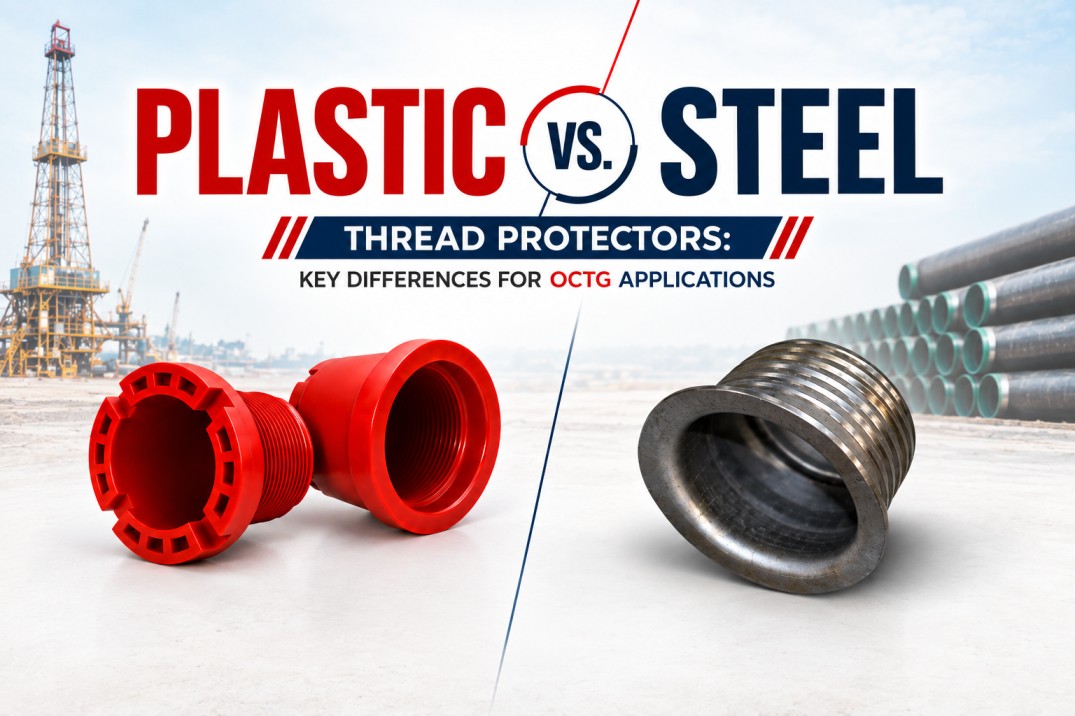
Plastic thread protectors are designed to cover and protect threaded pipe ends during storage, handling, and transportation. Their lightweight construction makes them easy to install, remove, handle, and transport.
They are suitable for various casing and tubing applications where effective thread coverage is required without adding significant weight to the tubular product. Properly designed plastic protectors can help reduce exposure to dirt, dust, moisture, and routine handling damage.
Plastic protectors are a practical choice for applications where lightweight protection, ease of handling, and cost efficiency are important considerations.
Key Benefits of Plastic Thread Protectors
- Lightweight and Easy to Handle– Their lightweight construction makes installation, handling, storage, and transportation more convenient.
- Simple Installation and Removal– Designed for convenient fitting and removal, helping simplify routine handling operations.
- Resistance to Rust and Moisture– Plastic does not rust and can provide effective protection where exposure to moisture may be a concern.
- Suitable for Casing and Tubing– Designed for various casing and tubing connections and protection requirements.
- Helps Prevent Contamination– Helps keep threaded connections protected from dirt, dust, moisture, and other external contaminants.
- Cost-Effective Protection– Provides a practical and economical option for many routine OCTG protection requirements.
What Are Steel Thread Protectors?
Steel thread protectors are designed for applications where greater mechanical strength and impact resistance may be required. Their robust construction provides additional physical protection to threaded pipe ends exposed to demanding handling and transportation conditions.
Steel protectors are commonly considered for heavy-duty applications where pipe ends may experience greater external forces during movement, stacking, loading, unloading, or transit.
Their rigid construction makes them an appropriate option when durability, mechanical strength, and resistance to physical impact are important selection factors.
Key Benefits of Steel Thread Protectors
- High Mechanical Strength– Robust construction can provide strong physical support for threaded connections under demanding conditions.
- Strong Impact Resistance– Designed to withstand higher levels of physical impact during loading, unloading, transportation, and handling.
- Suitable for Demanding Conditions– Appropriate for OCTG products exposed to frequent movement or challenging handling environments.
- Durable Construction– Steel construction can provide robust protection for demanding OCTG applications.
- Protection During Transportation– Helps safeguard critical threaded connections against potential physical damage during transit.
- Enhanced Physical Protection– Suitable for applications where increased strength, rigidity, and mechanical protection are important.
Plastic vs. Steel Thread Protectors: What Are the Main Differences?
| Comparison Factor | Plastic Thread Protectors | Steel Thread Protectors |
| Material & Construction | Manufactured from suitable polymer materials, providing lightweight construction and natural resistance to rust. | Manufactured using robust metal construction, providing greater rigidity and mechanical strength. |
| Weight | Lightweight, making installation, removal, storage, and handling more convenient. | Heavier than plastic protectors, but provide increased strength for demanding applications. |
| Impact Protection | Provides effective protection for routine OCTG handling and transportation when correctly selected and fitted. | Can provide enhanced mechanical protection where threaded connections may be exposed to higher physical impact. |
| Environmental Considerations | Does not rust and is suitable where moisture exposure may be a concern. | Appropriate material, coating or finishing and proper storage practices may be required depending on environmental conditions. |
| Handling Convenience | Lightweight construction makes handling large quantities relatively convenient. | Greater weight and rigidity may require comparatively more effort during handling and installation. |
| Cost Considerations | Generally, provides an economical option for routine and high-volume protection requirements. | May have a higher initial cost, but its mechanical strength can make it suitable for demanding protection requirements. |
Which Thread Protector Is Right for Your OCTG Application?
The right thread protector depends on the OCTG product, connection type, handling conditions, transportation requirements, storage environment, and required level of protection. Selecting the appropriate protector can help maintain thread condition throughout storage, transportation, and handling.
Plastic thread protectors are generally suitable when lightweight construction, easy handling, moisture resistance, and cost efficiency are important. They can provide practical protection for routine casing and tubing applications where moderate handling conditions are expected.
Steel thread protectors may be preferred for applications involving heavier handling, greater impact exposure, stacking, loading and unloading, or demanding transportation conditions. Their robust construction can provide increased rigidity and mechanical protection.
At DIC Oil Tools, thread protection solutions are available for different OCTG requirements. Customers should consider connection specifications, environmental conditions, handling requirements, and applicable industry or purchasing specifications when selecting the most suitable protector for their application.
Importance of Thread Protection in OCTG
OCTG casing and tubing connections are critical components of well construction and production operations. Before installation, these threaded connections may pass through multiple stages of storage, transportation, loading, unloading, and handling. Proper thread protection helps maintain their condition during these stages.
Effective thread protection can help:
- Preserve thread profiles and connection condition.
- Reduce the risk of handling-related thread damage.
- Limit exposure to dirt, dust, moisture, and foreign materials.
- Support proper storage and transportation.
- Reduce the need for unnecessary repair or reconditioning.
- Keep threaded connections protected until installation.
Selecting the appropriate thread protector is therefore an important part of maintaining OCTG connection quality throughout the supply chain.
Factors to Consider When Choosing Plastic or Steel Thread Protectors
Before choosing a thread protector, OCTG manufacturers, distributors, and operators should consider several important factors.
Type of OCTG Product: Casing and tubing products can have different connection configurations and protection requirements.
- Thread Type and Size: The protector should properly match the applicable connection profile and pipe dimensions.
- Handling Conditions: Repeated movement, heavy loading, stacking, and demanding field conditions can influence the required level of mechanical protection.
- Transportation Conditions: Distance, loading methods, movement, and other transit conditions should be considered when determining the appropriate protector.
- Storage Environment: Exposure to moisture, dust, temperature variations, and outdoor conditions can influence material selection.
- Impact Exposure: Applications involving a greater possibility of physical impact may require a stronger and more rigid protection solution.
- Applicable Specifications: Where specific industry standards, customer specifications, or purchasing requirements apply, the selected protector should be evaluated against those requirements.
Why Quality Matters in Thread Protectors
Regardless of whether plastic or steel construction is selected, quality and correct fit are essential for effective thread protection. A properly designed protector should provide appropriate coverage, fit securely, and remain in position during expected storage, transportation, and handling conditions.
Material selection, dimensional accuracy, manufacturing quality, strength, and connection compatibility should all be considered when evaluating a thread protector. Selecting a protector based solely on price may not provide the level of protection required for the specific OCTG application.
As a thread protector supplier and exporter, DIC Oil Tools supports OCTG requirements with quality-focused protection solutions designed for casing and tubing applications.
Conclusion
Both plastic and steel thread protectors have important roles in OCTG applications. Plastic protectors offer a lightweight, practical, rust-resistant, and economical option for many casing and tubing requirements, while steel protectors can provide increased rigidity and mechanical protection for more demanding handling and transportation conditions.
The appropriate choice depends on the OCTG product, connection configuration, expected handling conditions, storage environment, transportation requirements, applicable specifications, and required level of protection.
DIC Oil Tools provides reliable plastic and steel thread protection solutions for OCTG applications, helping customers protect critical casing and tubing connections throughout the supply chain.
For suitable thread protection solutions, contact DIC Oil Tools to discuss your specific OCTG application and requirements.